
I first contacted Mr. Phillip Bayt, the Mayor of Indianapolis, Indiana, in 1969. In his beautiful reply he confirmed his Slovenian roots and also reminded me — and now reminds all our readers — of the enormous sacrifices endured by his and many other immigrant parents, in what was initially for them a foreign land, speaking a different, incomprehensible language and following strange, different customs.
It is easy to imagine that their American neighbors had difficulty pronouncing their last name Bajt. It probably sounded something like “dg†in the word budget. “Your request for information,†wrote Mayor Bayt, “reminds me of the tremendous sacrifice made by parents of first-generation Americans. There were eleven children in my family, nine boys and two girls. I was the oldest boy and l am aware from personal knowledge that both my father and mother made many sacrifices so that their children had a good home and received at least an opportunity for
education.†This tribute to his father Filip and mother Antonia was made by Phillip Bayt whom the Indianapolis News called “one of the best mayors in the city’s history — if not the bestâ€; thus, Bayt has joined the list of American best mayors, including Lausche and Voinovich, who were of Slovenian descent.
America was always a country of opportunity, yet, unlike Mayor Bayt, most descendants of immigrants have no idea of the sacrifices their immigrant ancestors had to make and problems they had to overcome to give their children a better chance in life than what they themselves had encountered. Thus, James J. Divita, Ph.D., Professor of History at Marian College (later University) in Indianapolis, devoted a chapter of his excellent book, SLAVES TO NO ONE: A History of the Holy Trinity Catholic Community on the Diamond Jubilee of the Founding of Holy Trinity Parish (1981), to “Aspects of Slovene Life in Haughville,†Indianapolis, where parents of the future mayor and many other immigrants had settled.
[pc-pvt-content allow=”91″ warning=”1″ message=”Please login to see more.” login_lb=”74″ registr_lb=”74″]
As he writes in 1925, Vera Morgan, the librarian at the Haughville branch, 519 Belleview Place, lamented the lack of interest in, and information available on, the immigrant families in her district. She pointed out that in an interview some time ago, a prominent writer referred to Indianapolis as the typical American city, a city which had practically no foreign population and in which the sturdy and liberty-loving New England was blended with the cultural and aristocratic South. We have always fostered that idea and we love to have people come and tell us that. And if now and then in the newspapers (chiefl y in the birth statistics and reports of industrial accidents) we read a name that is neither Lowell or Bradford nor Lee, we pass over it to more agreeable news.
But if you were so impolite as to press the subject and ask if we really had no foreigners, we would have to say “Oh yes there are a few hunkies out in Haughville but we don’t know anything about them.†Two Indiana University graduate students discovered this lack of information, wishing to research the Slovenes for their master theses in 1930, they found that not one book for the Slovenes stands on the shelves of the Indiana State Library or Indianapolis Public Library (Divita, p. 43). So, who were these “hunkies in Haughville� Who were these unknown people, the Slovenes? … The normal day for a Slovene man began early in the morning.
Although the Malleable whistle sounded at 7 a.m., sometimes he reported at 4 a.m. to prepare the furnaces. His normal work day could vary depending on whether he was core maker, patt ernmaker, or molder and whether he worked the day or night shift. Foundry work was hard, hot and tiring. Summer temperatures rose to 140 degrees. Winter temperatures might be below freezing, as cold air rushed in whenever doors needed to be opened…. His only break was for lunch when a family member appeared at the foundry window and passed in a lunch bucket. For all of this he was paid 10 to 15 cents an hour in 1910. Or he was paid by the piece and was docked if he made too much scrap. … Normally, the Slovene woman was responsible for housekeeping, meal preparation, tending the children, and looking after boarders. The boarders, unmarried young men, usually paid $6 monthly for room, meals and laundry (Divita, pp. 43. 45).
Let us add that there were no modern appliances at that time, that wood and coal were used for cooking and heating, and there were no wash machines, no refrigerators and no air conditioning. Now remember that the Bajt family consisted of two parents, nine sons and two daughters, meaning that thirteen persons, including eleven children, had to be fed and cared for each day in this working-class neighborhood. Thus, it is not diffi cult to understand why Mayor Phillip Bayt wrote to me in 1969, “I was the oldest boy and l am aware from personal knowledge that both my father and mother made many sacrifi ces so that their children had a good home and received at least an opportunity for education.†Phillip L. Bayt, the oldest son of Slovenian immigrant parents, the so-called Hunkies, was born on September 29, 1910, in Haughville, Indianapolis, where he attended the local grade school and graduated from George Washington High School.
Later, as a notable citizen who has made it in America, he became the first recipient of its Outstanding Alumnus Award. He served as a secret agent during World War II and, after returning to Indianapolis, became city controller and municipal court judge. A Democrat, he was first elected mayor of Indianapolis on November 12, 1950, and served an incomplete term; re-elected in 1956, he served with distinction until 1959, having been called by the Indianapolis News “one of the best mayors in the city’s history — if not the best.†He was also Marion County prosecutor and Chairman of Public Service Commission of the State of Indiana. Mayor Bayt married his fellow-Slovenian Mary (Mitzi), nee Stanisa, five years his junior. They had two sons. Phillip A. Buddy Bayt was born In 1933 and grew up in Haughville. He graduated from Cathedral Latin High School where he was a lett ered football and basketball player and excelled in golf. Later, in the 1970s, he played in several City Golf Championships. He graduated from Indiana University in 1958 and Indiana University School of Law in 1961, then had a private law practice, worked for state government as a lawyer, was an Army war veteran of the Korean War and worked for Veterans Administration and was a Federal Government judge for 15 years.
He died in 2003 and was buried from the Slovenian Holy Trinity Catholic Church. (See Obituary, The Indianapolis Star, January 28, 2003). The second son of Mayor L. Phillip and Mary Mitzi Bayt was Robert L. Bob Bayt, who was born in 1940 and grew up in the Slovenian neighborhood of Haughville. He attended Holy Trinity Catholic Church and Cathedral High School where he lettered in basketball and golf, graduating in 1958. According to The Indianapolis Star (January 28, 2003), his zest for adventure led him to join the Marine Corps after High School where he was recognized as a Rifl e Expert and served as a Tank Mechanic in the Third Tank Batt alion. He traveled to Okinawa, Japan and the Philippines during this tour.
Although adventurous, he loved learning and returned to study at Butler University where he graduated with a degree in journalism. Then he joined the Peace Corps in 1965 and served in Copan, Honduras for two years. Thereafter, he went back to school and graduated from Indiana University School of Law where he also met and married his wife. Bob became a Public Defender, then worked in private practice and was eventually nominated to the United States Bankruptcy Court where he served for 23 years, nine of these as Chief Judge. (“The Honorable Robert L. ‘Bob’ Bayt†(The Indianapolis Star, May 18, 2017).
This, very briefly, concludes the story of Slovenian immigrants Bajt and their progeny, including Phillip Bayt, one of the best mayors of Indianapolis and their sons and grandchildren. The hunkies from Houghsville pursued and reached their American Dream, proving again that Slovenians, too, can make it in this great country of opportunity. Let us add that Prof. James J. Divita has introduced in his excellent book (p. 7) “The First Slovene in Indiana†Peter Pohek, the first Slovene recorded to have settled in Indiana. He was born in the parish of Cernomelj near Metlika in Southern Carniola probably in 1771. An adventuresome fellow, he joined Napoleon’s army and sett led in the French province of Alsace. There he married Mary Edgy. In the fall of 1827 they and their fi ve children sett led near New Alsace, Dearborn County, Indiana. Pohek bought land directly from the government and built a good log house on his farm. To his German neighbors he was known as Peter Buchter, because the Slovene word potok was similar to his name. Potok is Bucht in German and means ‘creek.’ Pohek contemplated moving from New Alsace because a Catholic church was too far away. On April 12, 1831, Rev. Frederic Baraga left Cincinnati for New Alsace. He had been an assistant at Metlika for two years before arriving in America a few months earlier.
Pohek was pleased to attend Baraga’s Mass and to have him teach the catechism to his children. During his three days there, Baraga heard Pohek’s and the others’ Easter confessions. Baraga likewise was happy to meet Pohek. He declared that he understood better the old saying “You find a Carniolan everywhere†[Kranjca povsod najdeš!]. After Baraga›s visit, a priest regularly served New Alsace. So Pohek remained until his death in 1854. Baraga, on the other hand, became a missionary to the Indians in the Upper Peninsula of Michigan.
In 1853 he was consecrated bishop, the first Slovene member of the American hierarchy. He died as Bishop of Marquette, Michigan, in 1868, and is presently a candidate for sainthood. Finally, according to Devita (op.cit., p. 85) a century after Pohek, the broader outlook developing around Holy Trinity began to produce political leaders and intellectuals, Phillip Bayt, born on Warman Avenue, became mayor of Indianapolis in 1956. Gerald Zore, a 1955 Holy Trinity School graduate and Marian College honors student, was elected judge in the Marian County Superior Court in 1974. Lawrence Broderick (?) became Marioan County Sheriff in 1975 … Joseph Turk taught languages at Marian College. Frank Velikan, Jr., became principal of Cardinal Ritter High School in 1972. Divita also lists numerous Slovenian fraternal lodges, sport groups, and social clubs, mirroring those in Chicago, Cleveland, Pittsburgh, and elsewhere, in addition to such institutions as the Holy Trinity Parish, schools, and a Slovenian national home. It was this writer’s wonderful privilege to be the speaker on Slovenian heritage and contributions at the Slovenian National Home in Indianapolis as the invited guest of the Slovenian Cultural Society of Indianapolis on March 12, 1994, and presenting a small exhibit, including an enlarged photo of Phillip Bayt, “one of the best mayors in the City’s history, if not the best one.â€
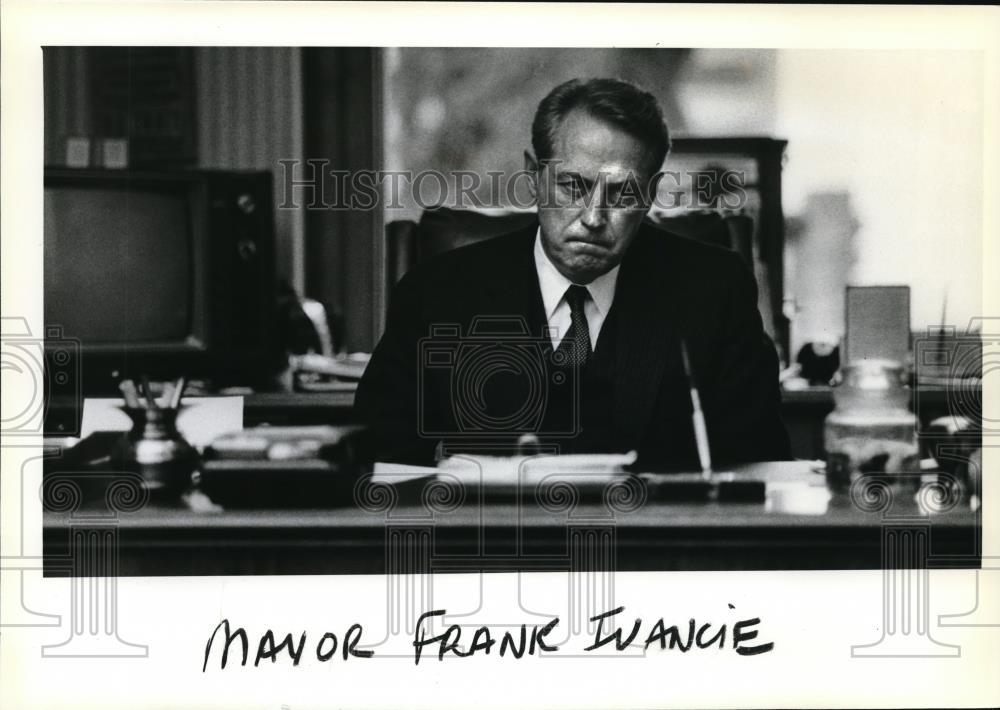
Slovenians in Indianapolis can, indeed, be proud of their contributions to the city and to America. Frank Ivancie, Mayor of Portland, Oregon Having seen Frank’s last name Ivancie, I suspected that it was originally IvanÄiÄ and was later Americanized to Ivancie. I wrote to Mayor Frank Ivancie and, in 1982, received a lett er from his brother, Gerald P. Ivancie, D.D.S., a dentist specializing in periodontics, in Denver, Colorado. He answered on behalf of his brother Frank, then Mayor of Portland. Yes, “the mayor is of total Slovenian descent and has risen as a fi rst-generation American Slovene to a position of distinction.
Our father John Ivancic was born in 1894 in the Istrian village, Male Loce (LoÄe), between Trieste and Reka. Our mother’s maiden name was Majerle, whose family was from Semic (SemiÄ) and Kot (in Bela Krajina, Slovenia). According to Wikipedia and various submitted documents, the Ivancic family sett led in Marble, Minnesota, located northwest of Duluth. There Frank, the future Mayor of Portland, Oregon, was born on July 19, 1924. After completing primary and secondary education at local schools, Frank graduated from the University of Minnesota with a bachelor’s degree in sociology. He subsequently moved to Oregon, where he earned a master’s degree in education from University of Oregon. During World War II, he served in the U.S. Army Air Corps. After the war, he began working as a teacher in Burns, Oregon, where he met his future wife Eileen O’Toole with whom he had ten children. He moved to Washington County, in the Portland Metropolitan area, to take a position as principal of Orenco School. After a period in the 1950s working in England as principal of an American school run by the Department of Defense, Ivancie returned to Oregon and taught for Portland Public Schools. He left teaching in 1956 when hired as executive assistant to then mayor-elect Terry Schrunk. Ten years later, he was first elected to Portland City Council. He was re-elected in 1970, 1974, and 1978.
He served only the fi rst two years of the fi nal term. While serving as councilman, he was also Commissioner of Public Aff airs and directed the Department of Public Safety. Unsuccessful in 1976 in his fi rst campaign for mayor of Portland, Ivancie entered and won the primary campaign in May 1980, when the city, the largest in Oregon, counted 366,383 inhabitants. (In 2016, Portland’s population was 632,309, making it the 26th largest city in the United States; the third most populous city in the Pacific Northwest, after Seatt le and Vancouver. Because of its many rose gardens, Portland is known as the City of Roses.) Oregon’s Own Magazine Portland (November 1980), published a feature article with the new mayor’s photo on the cover and an unsigned article on pages 48 and 49, titled “Meet Your New Mayor†— what kind of a man is mayor-elect Frank Ivancie?
In the limelight over the past 13 years, Frank Ivancie’s public life has been the subject of continuous scrutiny. And what comes out of it? The portrait of a man with a clear perception of what needs doing. A man of action — a dynamo some call him — who gets things done. A hard-working man who puts in long hours, a man with a long series of credits and accomplishments in his name. A man who fi ghts tenaciously and vigorously for what he believes. A man who unabashedly told the citizens of Portland during his recent campaign, “I want to be your mayor.†Well, he will be our mayor on November 25th. He will bring to that offi ce, perhaps, more experience and a longer list of accomplishments than any other mayor of recent times. His record, he says, speaks for itself. We agree. Something positive has come to Portland under his administration of each of the departments he has headed as a City Commissioner since 1967.
Frank Ivancie is currently working on the renovation of the Civic Stadium. At his instigation the City Council has placed a $ 9.5 million bond issue for upgrading the stadium on the November ballot. The $9.5 million will buy new concessions, restrooms, structural repairs, and visual improvements; and a new roof line providing more covered seating. During his first term in office he was the Com- missioner of Public Aff airs. Under his administration of these Departments, Columbia pool was covered, outdoor pools heated, indoor tennis courts built, Pittock Mansion acquired, the stadium renovated, and the fi rst artifi cial turf put in, the Portland State South Park Blocks, and the Freedom Train brought to Portland. He accomplished the latt er by calling on community leaders to help by raising private funding for the project. In 1974 Frank became the Commissioner of Public Utilities. … As a result of his eff orts, the Portland Water Bureau has been able to embark in a major capital improvement program to benefi t both city and outside users. This included the new gravity-fed mains, the Powell Butt e reservoir (the largest covered reservoir on the West Coast), and the installation of an emergency ground water system. …
One of the most innovative of Frank’s accomplishments as Commissioner of Public Utilities has been the Bull Run Hydro Project. Today the advantages of small hydro projects are much touted, but way back when Frank outlined the plan to the City Council it was an idea that had to be fought for. Finally, the city received national att ention when he instigated the fi rst ever national design-bid competition for a public building. “It gave us the best design and most space for our money,†he says of the competition for the new Public Service Building. Architecture Record — which devoted a feature article to it in its August 1980 issue — describes Portland’s new offi ce structure as “the best ‘Post-Modernist’ work of major size or civic importance underway in the United States.†The article concludes with the following words: “We look forward to a continuation of Frank Ivancie’s leadership skills and wish him the best as Mayor of the City of Portland.†With so many remarkable accomplishments to his credit, Frank Ivancie was sworn in as mayor of Portland on November 24. 1980. With a population of 366,383, Portland was one of the larger American cities. (In 2017, counting 647,805 inhabitants, it is the 26th largest city in the United States.) Scott Callister in his article, “The Man Who is Mayor,†published in Northwest: The Sunday Oregonian Magazine, on December 27, 1981, writes, “Ivancie who has sung Portland’s praises as far away as Switzerland, admits to being a booster. “We can’t just sit in a cave, wearing sackcloth and ashes on our heads. We have to sell our wares, to get out there and mix it up.†And although he’s taken unpopular positions in the past, the voters in his most recent election took a decided liking to him. …
Unlike Reagan, Ivancie is a registered Democrat. But his conservative stands often prompt people to compare the two men. The descriptions applied by Ivancie’s colleagues and friends would probably please either man: pro-business, anti-Communist, family-oriented, hard-working. Also, “Ivancie said, ’Ronald Reagan chops wood while I like to work in the garden. It’s good to get perspective away from the offi ce.’ Ivancie has a fi rm belief in this country’s ability to do right. … He is an earnest four-square American.†“He is more than just casually interested in the city. He thinks the city should have everything — from a city band to the fanciest office building. Described as family-oriented, Ivancie and his wife, Eileen, have ten children, four of whom live with their parents and all of whom live in Portland. … The family, or at least those members in town, still gather for Sunday dinners, where the conversation naturally turns to politics.â€
According to WIKIPEDIA, “Ivancie’s tenure as mayor was scandal free. However, his conservative politics and pro-business positions were frequently controversial in Portland, a city with strong progressive leanings. He oversaw the construction of the Portland Building and advocated construction of wells to back up the Bull Run Watershed, the City’s primary source of drinking water. Much of the construction of MAX Light Rail Line occurred during his tenure.†His conservatism and comparisons with Reagan in a city with strong progressive leanings and some diffi – culties with a major Oregon newspaper may have resulted in Ivancie’s defeat in 1984. Then he briefl y headed the Oregon branch of Democrats for Reagan. He has been remembered by many inhabitants of Portland, as well as in several printed media, as a hardworking and skillful political leader with many positive achievements that benefi ted Portland and Oregon to his credit.
[/pc-pvt-content]
By:Â Edward Gobetz


Leave a Reply