

By: Sylvester Staniša
Four Slovenian Clevelanders – Peter Osenar, John Hocevar, Frank Vidmar, and Sylvester Staniša – recently traveled to Japan – to the “LAND OF THE RISING SUN.†We wanted to explore the ancient traditions coupled with state-of-the-art technology of this 3rd largest world economy (they dominate the world’s automotive industry) – to view the beauty of their landscapes – to visit their most famous religious temples and shrines and mostly to learn about the Japanese people and their cultures and of course to ride the bullet train and hopefully to hike Mt. Fuji.
[pc-pvt-content allow=”all” warning=”1″ message=”Want to see whole article? Please register or login with your account.” login_lb=”74″ registr_lb=”104″]
After arrival to Tokyo, we soon found out that our combined knowledge of Japan left much to be desired. We were astonished by the cleanliness of streets, property, and people – the formality of dress codes in business and social attire – most schools require uniforms and teachers are dressed formally. As we traveled into the country and observed the grandiose mountains, we were impressed by the lush greenery of cypress and cedar trees along with bamboos covering the mountainous landscapes as far as one can see. And of course, they do drive on the left side of the streets. But it was the people’s culture that impressed us the most – their politeness, dignity, adherence to basic human values, to assist one another as well as visitors. They seem to value life more than any place I have previously visited – as evidenced by one of the lowest crime rates in developed countries.
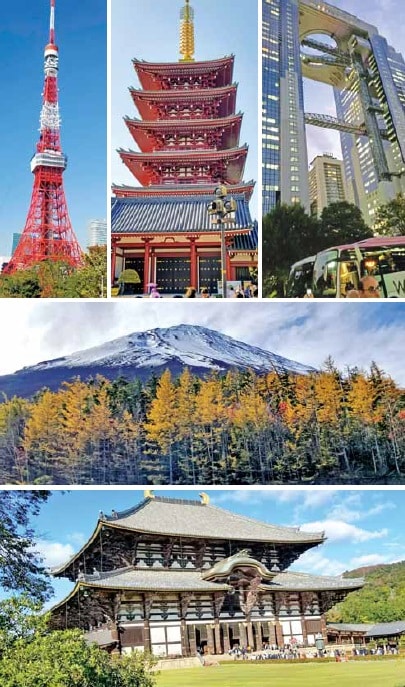
So, starting in Tokyo we visited the Imperial Palace, once the residence of Japan’s Imperial Family and on through the massive gates to the ancient Buddhist temple of Sensoji built in the 7th century and to the Kannon temple, one of the most visited spiritual sites in the world. We stopped for photos at the impressive Tokyo Tower – the world’s tallest self-supporting steel tower. Then on to Mt. Fuji – over 12,000 ft. high (Triglav sits at 9,396 ft.) – to view the breathtaking natural scenery of this mountain and the surrounding panorama. We could not go to the summit as it is still capped with snow at the upper level.
Our first “bullet train†or Shinkansen ride was from Tokyo to Osaka where we boarded from the famous Shinagawa Station. The train traveled at approximately 189 miles/hr. This travel time was under 3 hours as compared to about 9 hours if traveled by car. The ride is pleasantly smooth and relaxing. At Osaka we visited the dramatic Osaka Castle built as a display of power in the 16th century, strategically looming over the surrounding park and displaying an excellent collection of art and armor. Then on to the Kuromon Market, an Osaka landmark, to get a taste of Japanese cuisine and peruse through many, many shops. Again, it was fascinating observing the well-mannered shoppers even though the crowd was elbow-to-elbow.
And then a very solemn thought-provoking visit to Hiroshima where an atomic bomb was detonated on August 6, 1945, starting with a visit to the peace memorial, a historic site near where the atomic bomb exploded – dedicated to the many lives lost in this city. One of the main attractions here is a large building that somehow survived the attack and is still standing like a skeleton as if in defiance of such an unbelievable explosion. Today, Hiroshima once again represents a modern bustling city with major industrial capabilities – thanks mostly to the rebuilding efforts of the USA after the war.
Next, we visited the historic city of Kyoto, founded in the 7th century, one of the early capitals of Japan and home of the country’s most treasured remnants of Japanese imperial life. We started on the hillside of Kiyomizu Temple for an astonishing view over the city of Kyoto. Later we participated in a traditional Tea Ceremony experiencing the ritual art of preparing and serving green tea – tea powder as a whole is prepared in hot water and consumed – it ends up really deep green. Next, we visited the Gion section of Kyoto’s most famous Geisha district consisting of several streets of restaurants/bars still practicing the traditions of Geisha women entertaining guests in a manner performed during the Samurai area.
Finally, we visited Nara, the 8th-century Imperial capital. In this repository of Japan’s cultural heritage, there are eight World Heritage Sites and a wealth of historic treasures including Japan’s oldest Buddhist temples. As Japan’s religion is almost totally Buddhist, there are shrines and temples everywhere but very few churches – we did not see even one. Christian religion constitutes only about 1% of the entire nation. The temples and shrines are constructed of cedar or cypress wood predominantly, as it is very abundant, and carved with intricate details with unique painting effects making them very picturesque.
We learned that Japan is definitely not a melting pot of nationalities – they are almost entirely a single race and immigration is limited, allowing only work visas with no path to citizenship.
All in all, this visit was an eye-opener for us learning about the country that is a major economic player on the world stage but not much is known by outsiders of its culture and way of life. We learned that Japan still follows the educational and governmental systems established by General MacArthur, in charge of rebuilding Japan after 1945. [/pc-pvt-content]








Leave a Reply